7 Factors That Drive Chain Link Fence Installation Cost

Updated: Oct 27
Last Updated: October 25, 2026
Quick Summary
Chain link fence installation cost depends on fence height, linear footage, material quality, local labor rates, site conditions, and gates, with materials typically representing 40-50% of the total cost and labor making up the rest. A 150-foot, 6-foot galvanized residential fence with one gate costs approximately $4,682 in the sample estimate provided.
Materials typically represent 40-50% of total chain link fence installation cost, with labor making up the remainder.
Standard residential fabric is 11.5 gauge; heavier 9-gauge fabric costs more but resists impact and sagging better.
Rocky or clay-heavy soil, slopes, and tight access significantly increase labor costs by slowing hole digging and material placement.
A professional site visit is essential because calculators cannot assess ground composition, slope, and access constraints that dramatically affect real costs.
Permit fees, utility locating, and existing fence removal are common hidden costs that should be itemized separately in quotes.
Table of Contents
What Affects Chain Link Fence Installation Cost
Breaking Down Materials and Labor Costs
100 Feet of 6-Foot Chain Link Fence Cost
Understanding Chain Link Fence Labor Cost Per Foot
Black Chain Link Fence Cost and Coating Options
Using a Chain Link Fence Cost Calculator for Your Project
Site Conditions, Permits, and Hidden Costs
Getting Your Free Estimate
Frequently Asked Questions
What Affects Chain Link Fence Installation Cost
The chain link fence installation cost depends on several interconnected factors that determine whether your project runs a few hundred dollars or several thousand.

The primary cost drivers are fence height, linear footage, material quality, local labor rates, site conditions, and gates. Learn more about chain link fence installation services available in your area.
Height and length are the most obvious factors. A four-foot fence costs less than a six-foot one because it requires less fabric and shorter posts.
Material choice matters significantly. Galvanized steel (the standard) costs less than vinyl-coated options, and black chain-link carries a modest premium.
Breaking Down Materials and Labor Costs
Materials typically represent 40-50% of your total chain link fence installation cost, with labor making up the rest.
Sample itemized estimate (150 ft, 6-ft galvanized, one 4-ft gate)
Line item | Quantity | Unit | Unit price (USD) | Line total (USD) |
6-ft galvanized fabric (11.5 gauge) | 150 | linear ft | $7.00 | $1,050 |
Terminal posts (2-3/8 in.) | 4 | each | $28.00 | $112 |
Line posts (1-7/8 in.) | 24 | each | $16.00 | $384 |
Top rail (1-3/8 in.) | 150 | linear ft | $3.20 | $480 |
Tension wire, caps, ties, hardware | 1 | lot | $95.00 | $95 |
Concrete (80-lb bags, 2 per hole) | 56 | bag | $6.50 | $364 |
4-ft walk gate (kit) | 1 | each | $145.00 | $145 |
Labor (installation) | 150 | linear ft | $11.00 | $1,650 |
Site preparation (minor clearing) | 1 | lot | $150.00 | $150 |
Permit fee | 1 | each | $75.00 | $75 |
Sales tax on materials (7%) | , | , | , | $177 |
Estimated total |
|
|
| $4,682 |
These figures are illustrative and vary by market, gauge, coating, and access.
What moves the material lines
Fabric gauge and coating. Standard residential fabric is 11.5 gauge; heavier 9-gauge fabric costs more per foot but resists impact and sagging better. Vinyl-coated fabric (black or green) adds a premium over galvanized because of the extrusion step.
Post spacing. Posts set every 6 feet use fewer posts than 5-foot spacing but demand slightly heavier rail and tighter tensioning. Spacing closer than 6 feet raises post and concrete counts.
Concrete volume. A common pattern is two 80-lb bags per residential post hole, more in loose or sandy soil where the hole is bell-shaped. Concrete is a small line per bag but multiplies across 25-30 holes.
Rail and tension wire. Top rail runs the full length; bottom tension wire is optional but recommended on taller fences and slopes to keep fabric tight.
What moves the labor line
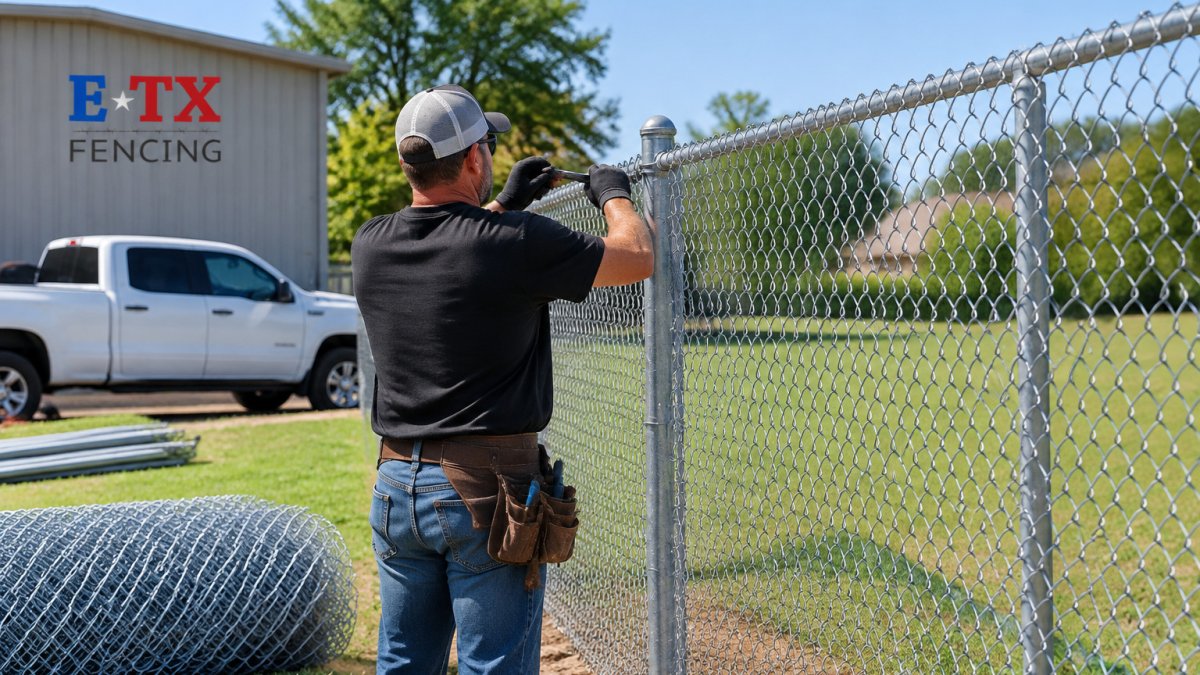
Labor covers layout, hole digging, setting posts, hanging rail and fabric, tensioning, and cleanup, quoted per linear foot, hourly, or as a project price. The per-foot figure rises when:
Soil is rocky, clay-heavy, or shallow to bedrock, slowing hole digging.
Terrain slopes, requiring stepped fabric and custom post heights.
Access is tight (narrow side yards, gated properties), forcing hand-carrying of materials.
An existing fence must be removed first.
A contractor quoting a single per-foot rate without assessing these variables is guessing. Ask for the labor line to state its assumptions about soil and access.
Pro Tip When comparing bids, normalize them: ask each contractor to quote the same height, gauge, coating, post spacing, and gate count. A lower total often reflects thinner fabric or wider post spacing, not a better deal.
100 Feet of 6-Foot Chain Link Fence Cost
A 100-foot section of six-foot chain-link is a common residential project, enough to fence a modest backyard or side yard.
Material costs include roughly 100 linear feet of six-foot fabric, 17-18 posts spaced 6 feet apart, 100 feet of top rail, hardware, and concrete for footings. Fabric is the largest material expense; posts, rail, and concrete add substantially.
Labor typically requires one to two days depending on soil and access. Post hole digging is the most time-intensive phase: soft, clear ground moves quickly, while rocky or clay-heavy soil slows work considerably. Once posts are set, fabric installation moves faster.
At this scale, per-foot costs become meaningful. A residential fence installation services guide can help you understand how this project fits into broader residential fencing work.
Understanding Chain Link Fence Labor Cost Per Foot
Chain link fence labor cost per foot varies by region, contractor experience, and site conditions, driven by local construction wages and demand.
Labor cost per foot is typically quoted as a range because site variables change installation time. To understand how chain link pricing compares to other fence types, review board-on-board fence cost per linear foot and other options.
Project size matters too. A 50-foot fence may cost more per foot in labor than a 200-foot fence because base time (arrival, setup, cleanup) stays constant while spreading across more footage.
Experienced installers and established companies with overhead, insurance, and equipment charge more than solo operators. Higher cost doesn't automatically mean better quality, but it's a factor in your estimate.
Black Chain Link Fence Cost and Coating Options
Galvanized steel is the budget baseline: zinc-coated, corrosion-resistant, durable, low-maintenance, but visually prominent in a landscape.
Black vinyl coating (polyvinyl chloride) covers the galvanized steel, providing the same corrosion protection with a darker aesthetic that blends into many residential settings.
Green vinyl coating costs similarly to black and appeals to homeowners seeking a fence that recedes into landscaping.
Coating affects maintenance minimally: all galvanized and coated chain-link needs occasional cleaning, not regular treatment like wood.
Using a Chain Link Fence Cost Calculator for Your Project
A chain link fence cost calculator systematizes the key variables for ballpark estimates. These tools are useful for initial planning but should never replace a professional site visit and quote.
Basic calculators ask for linear footage, fence height, material type (galvanized vs. coated), and gates, then multiply against average regional costs.
The limitation is that calculators can't assess site conditions. Rocky soil, slope, existing structures, and ground composition dramatically affect real costs but never show up in a calculator.
Use a calculator as a starting point for contractor conversations, not a replacement for actual quotes.
Site Conditions, Permits, and Hidden Costs
Site conditions are where many homeowners encounter cost surprises. What looks like a straightforward installation can change once the ground, access, and paperwork are assessed.
Pre-installation checks, in order
Confirm the property line. Pull your plat or survey and walk the line with the contractor. Building over a property line can force removal at your expense; a missing survey may require one before work starts.
Call 811 before you dig (811 Before You Dig). Utility locating is free in most areas and required before excavation. Marked lines may force post spacing changes or hand-digging near gas, water, or electric lines, both of which add labor.
Check local fence rules. Many municipalities limit height (commonly 6 feet in back yards, lower in front), set setback rules, and require permits for taller fences or front-yard fences. Homeowner association covenants can be stricter than the city.
Assess soil and slope. Probe the ground along the line. Rocky or clay-heavy soil slows digging; shallow bedrock may require alternative anchoring. Slopes require stepped panels and custom post heights.
Plan access and staging. Note where a truck can park and whether materials must be carried through a gate or narrow side yard.
How site conditions add cost
Rocky or clay soil. Hole digging is the slowest phase. Rock bars, augers, or alternate anchoring methods add labor hours and sometimes equipment rental.
Slope. A fence on a grade is built in steps so fabric stays tight and posts stay vertical. More terminal posts and extra fabric at each step raise material and labor.
Roots and obstacles. Trees, stumps, and existing structures force routing, extra terminal posts, or removal work.
Access constraints. Hand-carrying concrete and rail across a long distance adds time; so does protecting landscaping.
Existing fence removal. Removal and disposal are often quoted separately. Entangled vegetation or concrete footings make it slower.
Permits and paperwork
Permit requirements vary by jurisdiction.
Watch Out Do not let digging begin before utility locating is complete. Hitting a buried line is dangerous and can turn a fence budget into a repair bill.
Hidden costs to ask about explicitly
Permit fee and any inspection charge
Utility locating (usually free, but confirm)
Removal and disposal of an existing fence
Site clearing, grading, or landscaping repair
Gate hardware upgrades (self-closing hinges, latches)
Sales tax on materials and labor, which varies by state and locality
A quote that lists these as assumptions or exclusions is more honest than one that hides them in a single total. Compare bids on the same scope and the same assumptions.
Getting Your Free Estimate
The best way to understand your actual chain link fence installation cost is to request a professional estimate that accounts for your specific site.
When you get a free fence estimate, provide the contractor with accurate measurements of the area to be fenced, note any site challenges (slope, rocky soil, existing structures), specify your desired fence height and material preferences, and mention whether you need gates.
A professional estimate should itemize materials, labor, any site preparation costs, and optional items like gates.
Compare multiple estimates, but don't choose based on price alone. The lowest quote might reflect less experienced work or corner-cutting on post installation. The highest quote might include unnecessary upgrades.
ETX Fencing provides detailed estimates that break down materials, labor, and site-specific factors so you understand exactly what you're paying for.
Frequently Asked Questions
How much does chain link fence installation cost per linear foot?
Chain link fence installation cost per linear foot varies based on fence height, material grade, and local labor rates. A 4-foot galvanized chain link fence typically costs more per foot than a 6-foot version when labor is factored in, since setup and post installation remain relatively constant. Black vinyl-coated chain link costs more than galvanized. For an accurate per-foot price tailored to your property and specifications, contact ETX Fencing for a free estimate that accounts for your specific site conditions and material choices.
What is the cost difference between black chain link and galvanized fences?
Black chain link fence cost is higher than galvanized steel because the vinyl coating adds material expense and labor time. Galvanized chain link offers rust resistance through zinc plating at a lower price point, while black vinyl coating provides better aesthetics and durability against UV fading. The cost difference depends on fence height, length, and local material pricing. Galvanized is the budget-friendly option; black vinyl-coated is the premium choice for appearance and longevity.
How much does it cost to install a 100-foot fence?
The total cost to install a 100-foot chain link fence depends on height, material type, gate inclusion, and site conditions. A standard 4-foot or 6-foot fence requires different amounts of fabric and posts, affecting both materials and labor. Site preparation, soil type, and terrain difficulty also influence the final price. ETX Fencing provides free estimates that break down all costs, materials, labor, and any site-specific factors, so you know exactly what to expect before work begins.
Do I need permits to install a chain link fence?
Most residential properties require a building permit before fence installation, and property line verification through utility locating is essential to avoid conflicts with underground lines and neighbor disputes. Local codes govern fence height, setback distances, and material standards. Before installation begins, confirm your property lines and check with your local building department for permit requirements. ETX Fencing can guide you through these steps as part of your project planning.
The cost of installing a chain-link fence depends on factors you can control and others determined by your property. Understanding the breakdown between materials and labor, recognizing how site conditions affect pricing, and getting professional estimates from contractors who assess your specific situation all lead to better decisions. When you're ready to move forward, get a free estimate from a contractor who will evaluate your site carefully and explain the costs transparently.
Schedule Your Free Estimate
Add etxfencing.com as a preferred source on Google →